
How to Check Criminal History in Kinston
A useful Kinston criminal record check begins by identifying the document needed. Kinston Police Department owns the Kinston police report. The Lenoir County Sheriff manages the detention record after a person is booked, while the Clerk of Superior Court keeps the resulting criminal case. North Carolina eCourts Portal offers a public first look at docket data, but the clerk remains the custodian of the official court file. The North Carolina State Bureau of Investigation provides a fingerprint-based Right to Review for a Kinston resident examining their own statewide repository history.
- Ask KPD Records for the incident, crash, or arrest report and provide the case number or event details when known.
- Call Lenoir County detention when the immediate question is whether someone remains in custody.
- Search eCourts Portal with Lenoir County and Criminal Actions filters for charges, hearings, and dispositions.
- Contact the Lenoir County clerk for a Kinston paper file, certified copy, or the $25 certified single-county search.
- Use SBI Right to Review when checking and correcting your own fingerprint-supported North Carolina record.
The channels overlap, but they are not duplicates. A Kinston police report can contain event facts that never appear in the docket. Booking charges can change before a prosecutor files a case. A certified clerk search covers Lenoir County court records, not every Kinston police contact in the state. For broader county routing, the Lenoir County criminal history overview explains how those systems fit together.
Kinston Police Report Request Fields
Kinston Police provides a clear online form for common police copies. The official Request a Report form accepts incident, vehicle crash, and arrest report requests without requiring an account. It asks for contact details and lets the requester add the OCA case number, the involved person's name, the incident date and time, and further facts that help staff locate the right record. The form states that review and processing normally take three to five business days.
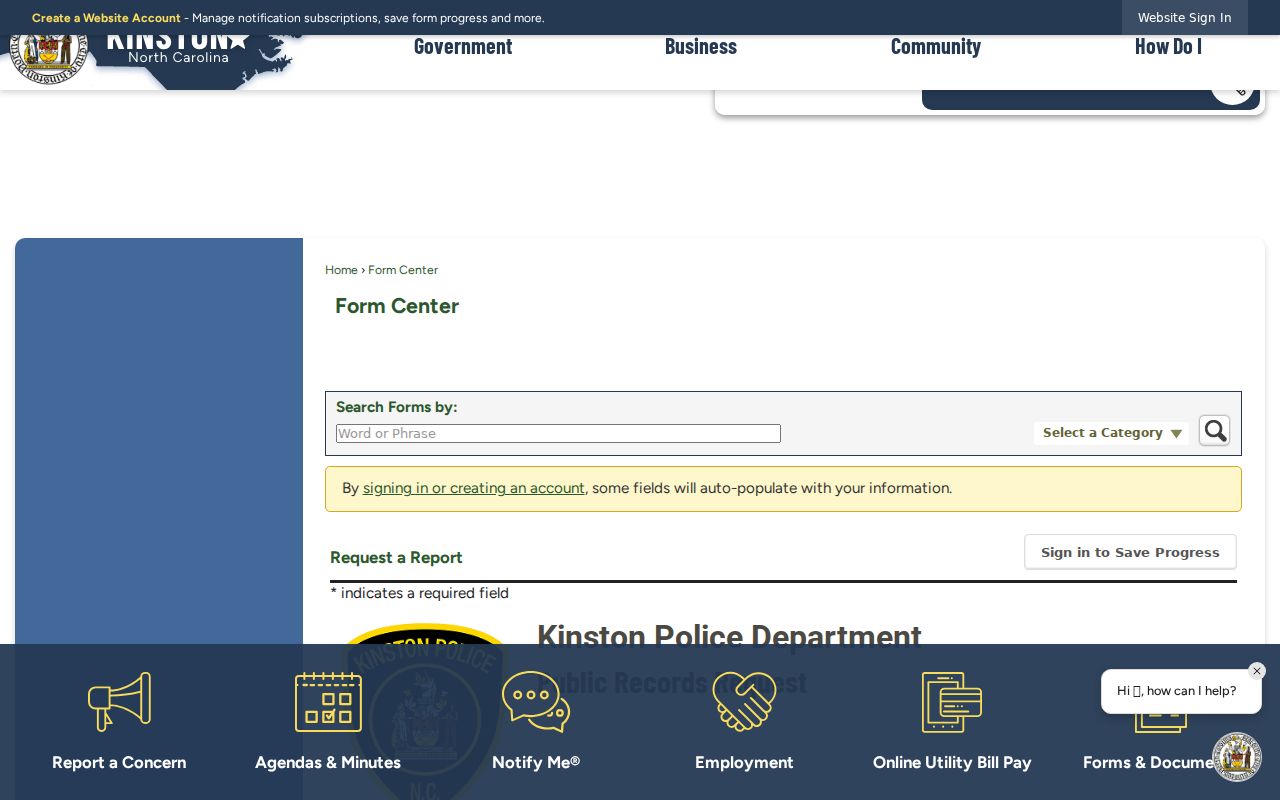
The captured form shows why a precise request tends to work better than a broad name inquiry. An OCA number is especially useful because it ties the request to the Kinston Police event file rather than a similarly named person. If no number is known, include the event type, date, place, and involved person. Police also publishes a separate self-generated incident report form for events within city limits. The email-copy box concerns the requested report, not a statewide Kinston background check.
| Form field | How it helps | Required |
|---|---|---|
| Name, email, phone | Lets Records identify and contact the requester | Yes |
| Report type | Incident, crash, or arrest report | Not stated |
| Case number | Uses the KPD OCA identifier | No |
| Person, date, time | Narrows the Kinston event | No |
| Additional information | Adds location or other identifying facts | No |
The Kinston Police Department
The Kinston Police Records Division is the first custodian for reports created by Kinston officers. The office is located at 205 East King Street, Kinston, NC 28501. The main police number is (252) 939-3160, and Records/Data can be reached at (252) 939-3169 or (252) 939-3220. The fax is (252) 939-3790, nonemergency dispatch is (252) 559-6118, and the records email is police.records@kinstonnc.gov.
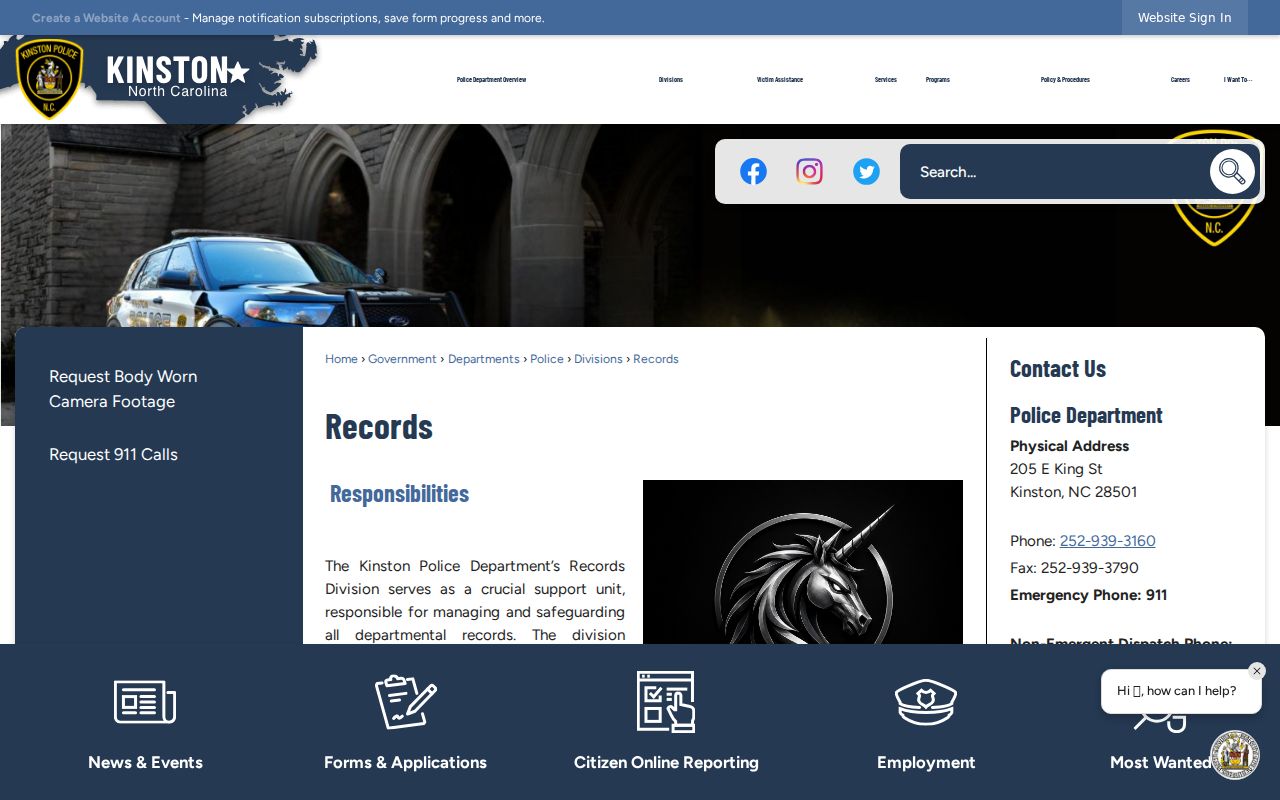
The official division page confirms that Kinston police records stay with the city even when the same event later produces a county jail booking or court case. The department also accepts a self-generated incident report for an event within city limits by hand, fax, email, or mail. An officer and supervisor review the signed report, and instructions say a completed report can be obtained two days after filing. That path documents a reported event. It does not establish that an arrest occurred or that a court found anyone guilty.
KPD Records Division
205 E. King St.
Kinston, NC 28501
(252) 939-3169
police.records@kinstonnc.gov
Kinston Body-Camera Record Access
Body-worn camera material follows a different Kinston record process. Kinston Police's camera footage instructions distinguish disclosure from release. Disclosure means viewing or listening under the statutory process. It does not permit the viewer to make a separate recording. Release of a copy requires a court order under G.S. 132-1.4A, so the standard police report form cannot substitute for that court-controlled route.
An eligible recorded person or a qualifying representative can submit Kinston Police's Video Disclosure Request at Records, email it to Video.Request@kinstonNC.gov, or mail it. A request for release uses AOC-CV-270 filed with the clerk in the county of the incident, followed by delivery of the file-stamped petition to Kinston Police. Death or serious-injury footage uses AOC-CV-275. The process shows why “public record” does not mean every Kinston police file is released in the same form or through the same counter.
Note: Ask for the ordinary incident report separately because obtaining basic event facts does not depend on receiving body-camera footage.
Arrests and Bookings in Kinston
Kinston Police creates the Kinston arrest report, but it does not operate the county booking system. A person taken into custody after a Kinston arrest is processed by the Lenoir County Sheriff at the W.E. “Billy” Smith Detention Center. Jail staff create intake data, record the booking charges and bond, photograph and fingerprint the detainee, and track release. The sheriff's official pages do not provide a verified public online jail roster. Call (252) 559-6100 for current custody, or ask Kinston Police and LCSO Records for the public facts held in their respective files.
North Carolina law preserves defined Kinston arrest information even when an investigative narrative is withheld. Under G.S. 132-1.4(c), public facts can include the arrested or charged person's name, sex, age, address, alleged violation, and the time, place, and circumstances of arrest. Request those specific fields if the full narrative is unavailable. A Kinston booking is evidence of intake and an allegation, not the final charge or a conviction. The prosecutor and court record control later outcomes.
Three Kinston Criminal Record Custodians
Kinston's city and county offices sit close together, but each answers a different records question. The official City of Kinston site supplies the municipal context for Kinston Police and city services.
The Kinston city image connects the Kinston agency to a chain that continues beyond Kinston Police. Kinston Police Records owns the report about the Kinston event. The sheriff owns Kinston booking and present-custody data. The Lenoir County clerk owns the Kinston prosecution file. Treating those Kinston copies as interchangeable can hide key changes, such as a booked charge that was later amended or dismissed.
| Custodian | Kinston record | Best use |
|---|---|---|
| Kinston Police | Incident and arrest report | Event facts and city officer file |
| Lenoir County Sheriff | Booking and custody record | Current detention, bond, intake |
| Lenoir County Clerk | District or Superior Court file | Filed charges, hearings, disposition |
Kinston Municipal Court Records
Kinston does not maintain a stand-alone city criminal court database. Kinston ordinance and traffic matters proceed within North Carolina's unified District Court structure, while Kinston felony trials belong in Superior Court. Both Kinston court divisions are served by the Lenoir County Clerk of Superior Court at 130 South Queen Street. Search eCourts or Court Dates with the Lenoir location filter rather than looking for a separate “Kinston Municipal Court” portal.
| Court Name | Lenoir County District Court and Superior Court |
|---|---|
| Case Types Heard | District Court handles misdemeanors, infractions, traffic matters, and preliminary felony events; Superior Court hears felony trials. |
| Case Lookup Channel | North Carolina eCourts Portal, Court Dates, courthouse terminal, or clerk request. |
| What the Docket Shows | Case number, charges, parties, hearings, events, dispositions, and financial entries when public. |
| Copies & Fees | Official copies come from the clerk; a certified single-county name search costs $25. |
The portal is close to real time but is not the official record. Unreturned warrants, sealed matters, juvenile cases, and other restricted content do not appear to an ordinary user. For a paper document, certification, or older file, contact the clerk at (252) 520-5300.
Finding Kinston Criminal Court Dates
Use Smart Search when the question concerns the full public docket. Use Search Hearings or the official Court Dates service when the immediate need is a scheduled time and place. A name or case number can start the search. Apply Lenoir County as the location and Criminal Actions as the category. Searching only for “Kinston” can miss cases because the judicial system indexes them at the county level.
A Portal case number has a two-digit year, a case-type code, a six-digit sequence, and a three-digit county identifier. Partial case-number searching requires at least four characters plus an asterisk. A wildcard name uses at least three letters of the last name plus an asterisk and one letter of the first name plus an asterisk. Registration saves cases but does not unlock more public data. If a new Kinston arrest is not visible yet, ask the clerk whether a case has been filed before assuming there is no record.
Where Kinston Records End Up
A Kinston event moves through custodians as the case develops. Kinston Police keeps its report. County detention creates the booking entry if custody follows. A magistrate addresses initial process and release conditions, and the clerk records charges, hearings, and outcomes. Fingerprint-supported arrest data can enter the SBI Computerized Criminal History repository, with a later disposition expected to connect to that arrest cycle.
Record flow: Kinston Police Department › Lenoir County Courts › North Carolina State Bureau of Investigation
That flow explains timing gaps. Recent Kinston police facts may exist before a court case appears. A dismissal may post after the booking file was made. The SBI record can lack an event that was never fingerprinted or can need correction when identifiers do not match. Compare dates, agencies, case numbers, and outcomes rather than relying on one name result.
When Kinston Charges Are Missing
No eCourts result does not prove that no Kinston arrest or report exists. Processing may still be underway, the name may differ, the prosecutor may not have filed a charge, or the event may be restricted. Start with the Kinston Police OCA number. Confirm current custody through the detention center, then ask the Lenoir clerk whether a criminal case has been created. An unreturned warrant will not appear to an ordinary Portal user.
If a case was dismissed, distinguish dismissal from expunction. North Carolina directs qualifying all-dismissed or not-guilty cases toward automatic expunction within 180 to 210 days after final disposition, but exclusions apply. Investigative records may remain with the arresting agency even after relief. Check the clerk's official file and, for your own statewide history, order a later SBI Right to Review before concluding that every system has been updated.
Note: A police OCA number and an eCourts case number identify different files, so preserve both when following a Kinston event.
Reading Kinston Crime Record Counts
Kinston publishes a Community Crime Map that updates daily and supports alerts, custom reports, and geographic review. The map can help identify reported-event patterns, but it is not a police report copy or proof of a court disposition. The KPD 2025 annual report separately recorded four Kinston homicide investigations, three cleared by arrest, and 17 Kinston cases involving people struck by gunfire, 14 cleared by arrest. Those are dated investigation and clearance figures. They are not Kinston conviction totals.
Always attach the source and year to Kinston crime statistics. Do not combine Kinston incidents, arrests, cleared investigations, jail bookings, or court convictions as if they measured the same thing. A Kinston map point describes an agency report. A Kinston clearance by arrest describes police action. Only the Kinston court file shows how a filed criminal charge ended.
Public Access Rules
Kinston police records are governed by North Carolina law, not by a general promise that the entire Kinston investigative file is open. Chapter 132 supports access to existing Kinston public records at reasonable times. G.S. 132-1.4 excludes Kinston criminal investigative and intelligence records as a whole while preserving defined public incident and arrest facts. Kinston court records are held for inspection and copying by clerks under G.S. 7A-109, subject to restrictions, sealing, and lawful fees.
Key Statutes:
North Carolina Public Records Law treats government records as public unless an exception applies.
G.S. 7A-109 directs clerks to maintain court records and provide lawful inspection and copies.
G.S. 15A-146 governs expunction of qualifying dismissals and not-guilty outcomes.
Make a focused Kinston request that names the event, date, Kinston Police number, and desired record. If the Kinston narrative is withheld, ask for the public fields listed in G.S. 132-1.4(c). For the official Kinston court result, use the clerk rather than asking Kinston Police to certify a prosecution outcome.