
Criminal Cases in the Lenoir County Courts
North Carolina Superior Court hears felony trials. District Court handles misdemeanors, infractions, and the early stages of felony matters. Both are divisions of the unified General Court of Justice. The Lenoir County Clerk of Superior Court maintains the files for both divisions, so there are not two separately elected record custodians. The Lenoir County clerk's office is at 130 South Queen Street, Kinston, with a main number of (252) 520-5300.
The District Attorney for Prosecutorial District 9 works from the courthouse and reviews Lenoir County prosecutions, but that office is not the custodian for court copies. Magistrates handle initial process, probable-cause duties within their authority, and release conditions. Their records and acts may feed the case, while the Lenoir County clerk organizes the official docket and filed documents.
| Court or office | Role | Contact |
|---|---|---|
| Superior Court | Felony trials, judgments, and official files through the clerk | (252) 520-5300 |
| District Court | Misdemeanors, infractions, and felony preliminary matters | (252) 520-5300 |
| Magistrates | Initial process and release conditions within their authority | (252) 520-5430 |
| District Attorney | Prosecution, not custody of the official file | (252) 520-5400 |
Lenoir County Criminal Cases After Track 8
Lenoir County moved into Enterprise Justice, also known as Odyssey, with eCourts Track 8 in April 2025. That change made the North Carolina eCourts Portal the main public online route for Lenoir County docket research. By October 13, 2025, all 100 North Carolina counties used Enterprise Justice. Searchers can now compare a Lenoir County case with a case elsewhere in the state through one system.
The transition did not turn Portal into the official Lenoir County record. It is close to real time, but the clerk still controls certified copies, paper files, material not migrated cleanly, and documents unavailable online. Portal registration does not reveal extra public information. It mainly permits users to save Lenoir County cases through My Cases. Anonymous public access is enough for ordinary Smart Search work.
How to Search Case Records
Use Smart Search for a Lenoir County case summary, Search Hearings for time and location, and the local criminal calendars for scheduling context. A Lenoir County case number is the cleanest identifier. A party name can also work, but name variants and common names make location and case-category filters important. The public system can show Lenoir County header data, parties, events, charges, hearings, dispositions, and financial information when available.
- Open eCourts Portal and choose Smart Search.
- Enter a party name or case number in Search Criteria.
- Open Advanced Filtering Options, choose Lenoir County, and set the category to Criminal Actions.
- Open the likely match and read the Case Summary and Register of Actions, checking filed charges and case status.
- Ask the Lenoir County clerk for a paper, copied, or certified document when the online view is missing or not official enough.
The official Portal training resources document the search controls and wildcard syntax.
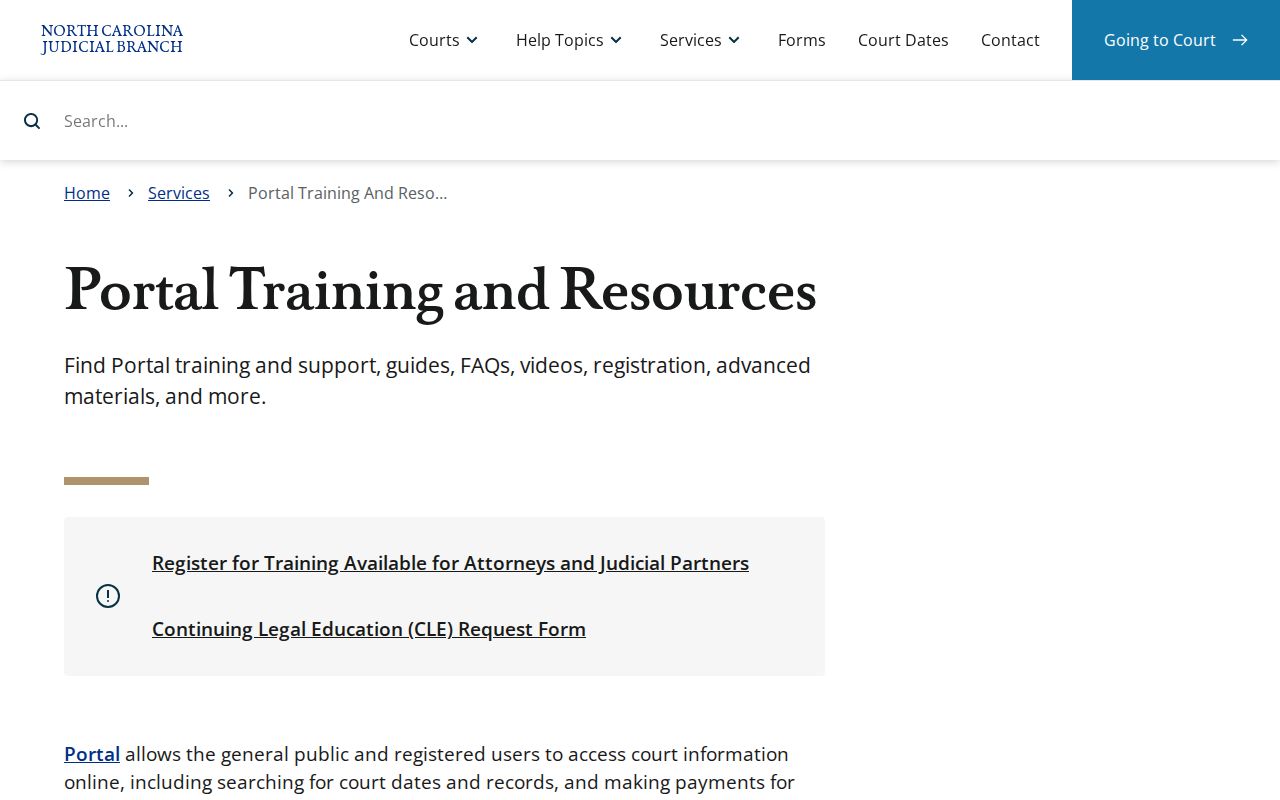
Those instructions also explain restricted access, single-document downloads, saved cases, and the distinction between a public online view and an official court record.
| Field label | Type | Required | Notes |
|---|---|---|---|
| Search Type / Smart Search | Tab | Yes | Separate from Search Hearings, payments, and judgment search. |
| Search Criteria | Text | Yes | Party name or case number; wildcard search is supported. |
| Location | Advanced filter | No | Select Lenoir County to narrow results. |
| Party Search Criteria | Expandable filters | No | Includes party name and documented birth-date filtering. |
| Case Category | Filter | No | Choose Criminal Actions. |
| Case Type | Filter | No | Options depend on the chosen category. |
| Case Status | Filter | No | Narrows active or disposed records. |
| Filing Date From / To | Date | No | Limits results to a date range. |
Decode Lenoir County Criminal Case Numbers
Enterprise Justice case numbers have four parts: a two-digit year, a letter case type, a six-digit sequence, and a three-digit county identifier. The research example is 21CR000003-910. The letters CR identify a criminal case type in that pattern, but the location filter remains useful, especially when a name search returns many people.
For a partial Lenoir County case number, enter at least four characters followed by *. For a name wildcard, use at least three letters from the last name plus * and one letter from the first name plus *. Portal works best in Edge or Chrome. Lenoir County search results should still be checked against file date, party role, case status, and judicial location before a person is treated as a match.
Note: A wildcard broadens the result set; it does not prove that two spelling variants refer to the same person.
What the Case File Shows
A Lenoir County criminal case file follows the prosecution, not the jail intake. It can contain a criminal summons, charging instrument, indictment, notices, motions, orders, hearing events, plea, verdict, judgment, sentence, and money obligations. Portal may link public documents one at a time. The Lenoir County clerk's paper or official electronic file controls when the online summary and an actual order differ.
| Case Number & Court | The identifying number, judicial location, case type, status, assignment, and judicial officer when entered. |
|---|---|
| Charging Document | The complaint, criminal process, indictment, or other filing that states the court charge. |
| Docket Entries | The Register of Actions, including filed events, motions, orders, and changes in status. |
| Hearing Dates | Date, time, courtroom, and hearing type when public and scheduled. |
| Disposition & Judgment | The result of each charge, such as dismissal, plea, conviction, or not guilty. |
| Sentence & Conditions | Custody, probation, restitution, costs, and other terms recorded in the judgment. |
Charges at booking can differ from charges filed by the prosecutor or returned by a grand jury. The filed court charge and its later disposition are the key fields for case-outcome research.
Lenoir County Criminal File Access
The courthouse counter and self-service terminals cover needs that Portal cannot. A user can search noncertified court records at a terminal without charge, and available records may be viewed or emailed. Printing can carry a cost. A certified name-based search uses Form AOC-CR-314 and costs $25. It covers Lenoir County only, even though a terminal can search more broadly.
The Lenoir County court contact directory identifies the clerk, judges, District Attorney, and magistrate numbers.
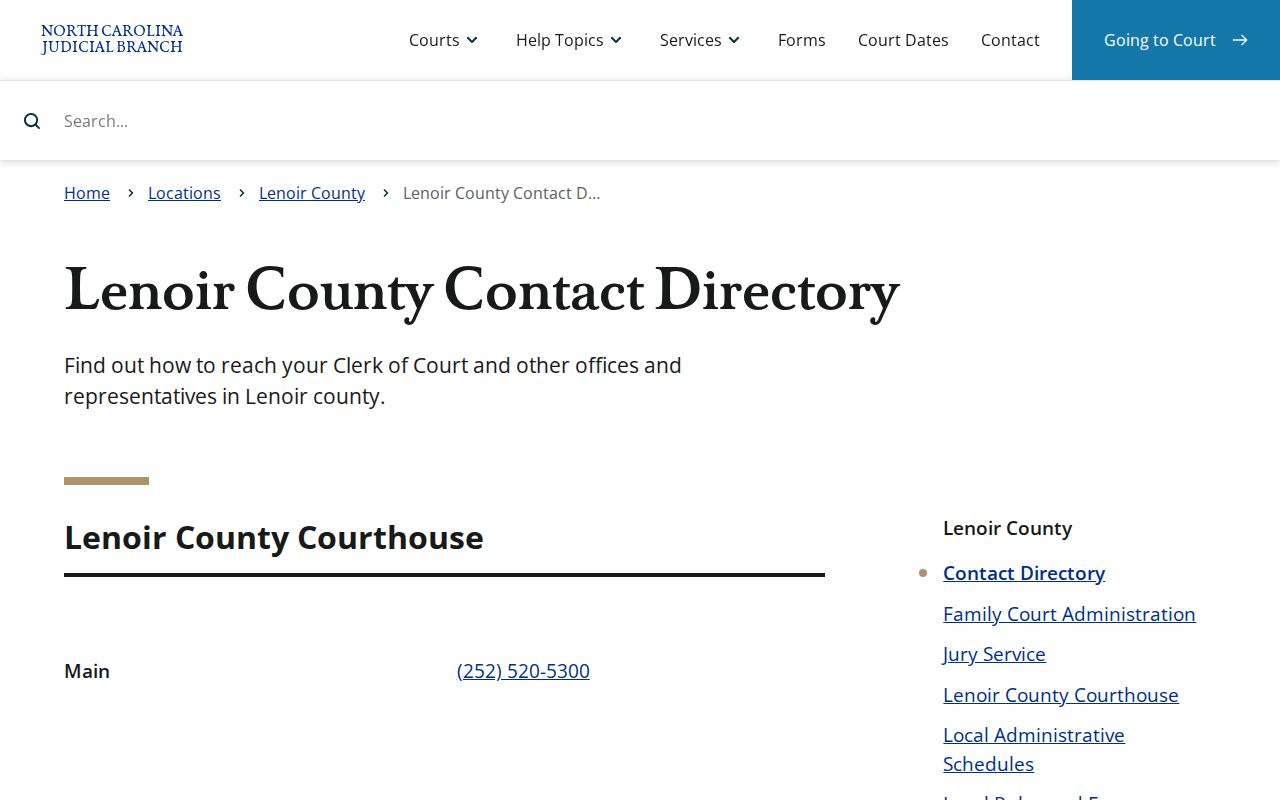
For mail requests, the clerk's address is P.O. Box 68, Kinston, NC 28501. The certified search accepts a money order or certified check by mail, not a personal check. In-person payment can use cash, credit card, money order, or certified check. Ask about document-copy and certification charges before placing a larger order.
Stages of a Criminal Case
A Lenoir County criminal case may begin with arrest, a criminal summons, or other process. A magistrate addresses the prompt initial appearance and release conditions. District Court handles misdemeanor cases and early felony matters. The prosecutor reviews the evidence and charges. A qualifying felony generally proceeds to Superior Court after indictment unless another lawful charging route applies. Arraignment addresses the charges and plea, and pretrial settings handle motions, discovery issues, and scheduling.
Case flow: Charges Filed › Arraignment › Pretrial › Plea or Trial › Disposition › Sentencing
The docket may continue after judgment through notice of appeal, probation matters, violation hearings, or correction of an order. Court entries should be read in date order. A future hearing does not itself state the outcome, and a single disposed charge may not resolve every count in the case.
Lenoir County Criminal Calendar Checks
Smart Search and Search Hearings answer different questions. Smart Search finds the case and its Register of Actions. Search Hearings focuses on the scheduled event. The Lenoir County local administrative schedules supply another official calendar route.
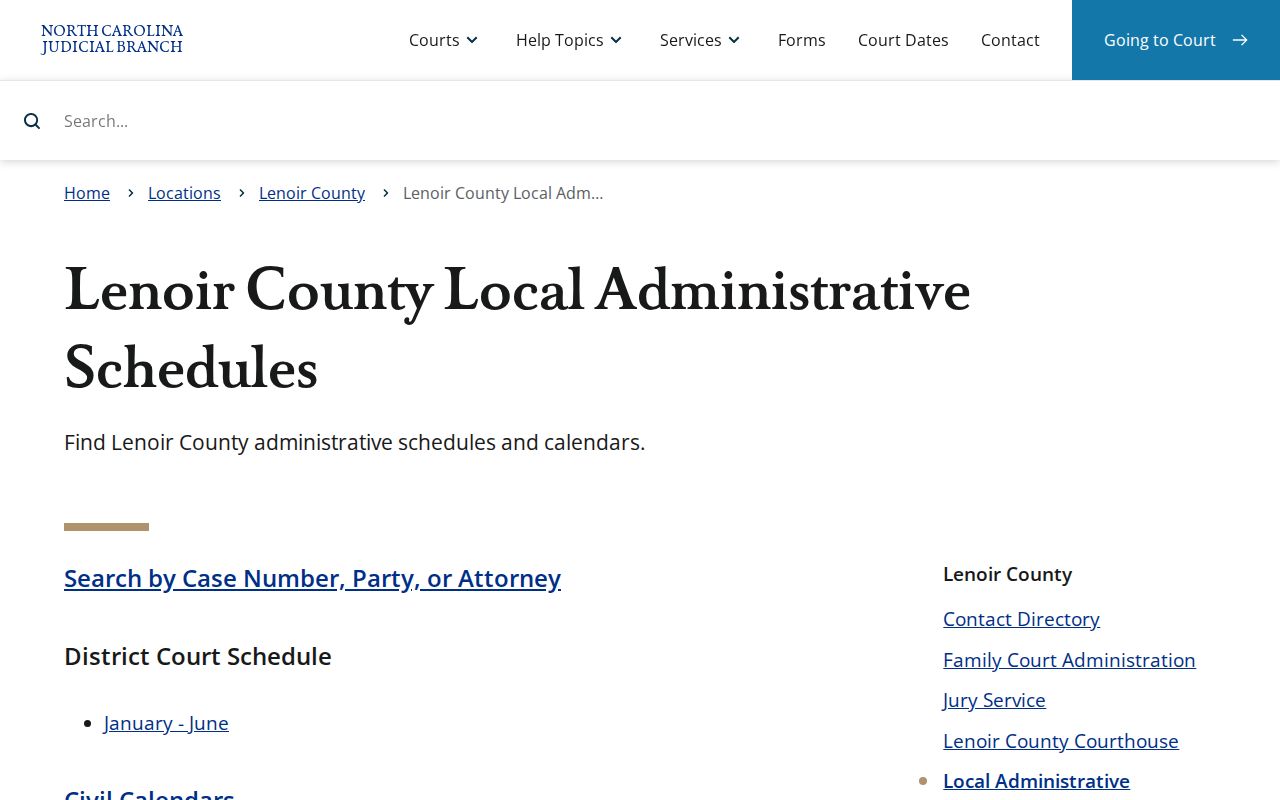
Calendar data is not a full case file. A scheduled setting can change, and a calendar line does not replace the later disposition or judgment. Check the Portal event, then confirm urgent appearance details with the clerk at (252) 520-5300. Magistrate matters have their own line at (252) 520-5430.
For a common name, pair the hearing information with the case number, court location, and party role. Do not use a date alone to identify a case.
Blocked Lenoir County Criminal Documents
Public documents download one at a time. Portal Error 141011 can indicate that a document is too large. When that happens, contact the Lenoir County clerk and ask whether staff can split the file or provide another copy method. Older or nonmigrated material may require a manual file or archive search. Give the clerk the case number, party name, and a clear description of the requested filing.
No online result can also reflect a spelling issue, the wrong county filter, a filing lag, sealing, expunction, a restricted case type, or a record that remains on paper. Search Hearings is not a substitute for Smart Search, and neither replaces a direct clerk inquiry. If the request concerns a court administration record rather than a case file, use the Judicial Branch public-record request route instead.
Access & Restrictions
G.S. 7A-109 requires clerks to keep court records and make lawful inspection and copies available, subject to fees and other law. Ordinary adult criminal case information is broadly accessible. Yet juvenile cases, sealed or expunged records, protected-order material, sensitive identifiers, and some victim information remain restricted. Portal documentation also places unreturned criminal warrants behind elevated access based on legal entitlement.
A missing restricted item should not be inferred from an unrelated docket line. The clerk may be able to confirm only what the law allows. Paper inspection also does not open sealed or confidential matter. For an official outcome, request the judgment or a certified search rather than relying on a screen capture.
North Carolina Public Records Law governs many government records, but court case access follows the clerk and judicial rules that apply to the file. A police investigative narrative belongs to the creating agency. The later court file belongs to the clerk. Keeping those custodians separate leads to a faster, more accurate request.